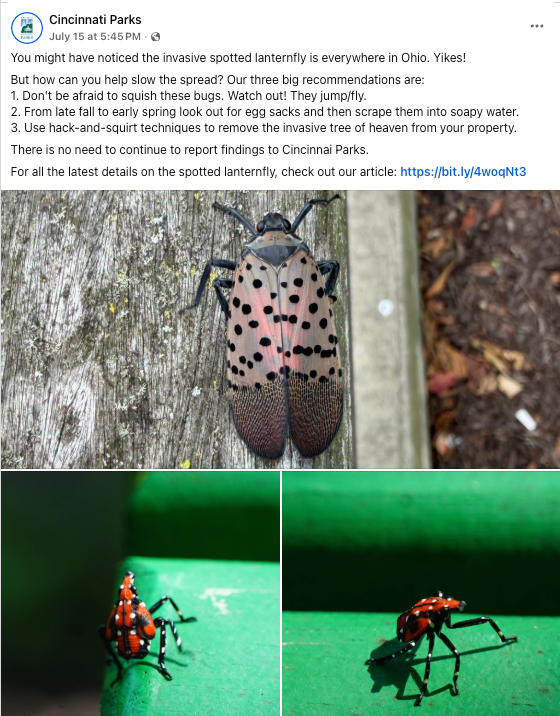
Cincinnati Parks published guidance on Tuesday, July 15, urging residents citywide to kill spotted lanternflies on sight. The red-winged pests are now so widespread that downtown sidewalks are littered with them, according to reporting by The Cooldown.
The advisory is citywide, but residents near east-side green spaces — including Ault Park and Owl's Nest Park in Hyde Park, Oakley, and Mount Lookout — should be on alert. Cincinnati Parks' Division of Natural Resources is already treating tree of heaven infestations on park properties.
"When you see 'em please squish 'em or crush 'em," Cincinnati Parks stated in its July 15 guidance.
What's at stake
The spotted lanternfly feeds on the sap of more than 100 plant species, with a particular appetite for grapevines, young maple and walnut trees, and tree of heaven. According to Cincinnati Parks' guidance, hundreds or thousands can gather on a single tree, weakening it and sometimes causing dieback. The insects excrete a sugary waste called honeydew that coats cars, sidewalks, and outdoor furniture, attracting other insects and promoting sooty mold — a black fungus that blocks photosynthesis on leaves.
The pest has no natural predators in North America.
A years-long problem
Cincinnati Parks first detected spotted lanternflies at Mt. Airy Forest and Parker Woods in 2023, according to a parks update written by Drew Goebel and Emma Wilson of the Conservation Land Management Team. The insect was first found in Pennsylvania in 2014 and reached Ohio in 2020. All 88 Ohio counties are under quarantine by the Ohio Department of Agriculture.
Cincinnati Parks says eradication is unlikely. The department's goal is coordinated management to limit damage and slow the spread.
What residents should do
Cincinnati Parks is asking neighbors to take three steps:
Kill on sight. Squish or crush adult lanternflies. Adults can fly short distances; nymphs can jump up to nine feet, according to the parks department.
Destroy egg masses. From late fall into early spring, scrape egg masses off surfaces — truck trailers, fences, outdoor furniture, firewood — with a knife or credit card edge, then drop them into a container of soapy water or rubbing alcohol.
Remove tree of heaven carefully. Never cut one down without first applying herbicide. Cutting alone can cause a single tree to sprout into a dozen. Cincinnati Parks recommends making angled downward cuts into the trunk spaced 2–3 inches apart, spraying systemic herbicide into the cuts, waiting a few weeks, then removing the tree. The best window for removal is mid-summer to early fall.
Reporting and resources
Cincinnati Parks says routine sighting reports are no longer necessary — the department is well aware of local infestations. Residents who still want to report can use the Ohio Department of Agriculture's reporting system or iNaturalist. The ODA has also published a Spotted Lanternfly Management Guide at dam.assets.ohio.gov.
Cincinnati Parks says it is developing educational programs to help residents manage the pest on their own property and in public forests. No dates for those programs have been announced.